

How does a scented ambiance improve your customers’ experience?
Share
A scented ambiance improves the customer experience by acting directly on the emotions: smell is the sense most quickly wired to memory and to feeling. An establishment that smells good is perceived as cleaner, more welcoming and more refined, before the customer is even aware of it. And when that fragrance stays the same from one visit to the next, it becomes a landmark: an olfactory signature that makes people want to come back.
Here is how it works, sector by sector, and what it takes for it to work for real.
What smell sets off in a customer
Smell does not travel through reason. Unlike what a customer sees or hears, what they smell reaches straight into the areas of the brain tied to emotion and memory. That is why a scent can change a mood in a few seconds, without anyone being able to say why.
In practice, four perceptions are settled in the first moments. Cleanliness first: a place that smells fresh is instinctively judged to be better kept, and the reverse is truer still. Comfort next: a soft scented ambiance signals that someone gave thought to the visitor’s experience, the way warm lighting or well-chosen music does. Refinement as well: the fragrance is taken as one more attention paid, the kind you notice in well-kept establishments.
Then comes the memory effect, the most lasting of the four. A customer who finds the same fragrance on every visit finds along with it everything attached to it: the memory of the first time, the sense of being in the right place. That is the principle of the olfactory signature: a distinctive, steady scent that becomes part of what a place is.
The concrete effects, sector by sector

In a hotel, the fragrance of the lobby sets the tone of the stay in the first few seconds. It reassures guests about how clean the property is and creates the landmark the traveller will find again on every return, one trip after another.
In a retail business, a pleasant scented ambiance invites people to slow down. A customer who feels good takes the time to browse, and a place that smells good gives an impression of quality that carries over to the products.
In a clinic or a care centre, the point is calm. These places often stir apprehension, and their typical odours add to it. A soft, fresh ambiance turns the wait into a more serene moment, for the patients and for the people who come with them.
In a seniors’ residence, the fragrance reaches both the residents, who live there, and the families, who are choosing where someone close to them will live. A fresh, warm scent reassures them about the quality of the place at the moment that trust counts most.
In a gym, freshness is almost proof: it says the air and the equipment are taken seriously. A member who breathes a clean environment comes back without second thoughts.
Well-being does not mean manipulation
Let’s clear one thing up, because the question keeps coming: scenting an establishment is not manipulating your customers. An ambient fragrance forces no one to buy and creates no artificial need. What it does is simpler: it makes the time spent with you more pleasant, the way a comfortable chair or a smiling welcome does.
The distinction counts, and not only for ethics. A customer who feels good comes back because the experience was good, not because they were caught in a trap. That is the relationship that builds a loyal clientele, and it is the only one that lasts.
What it takes for this to work
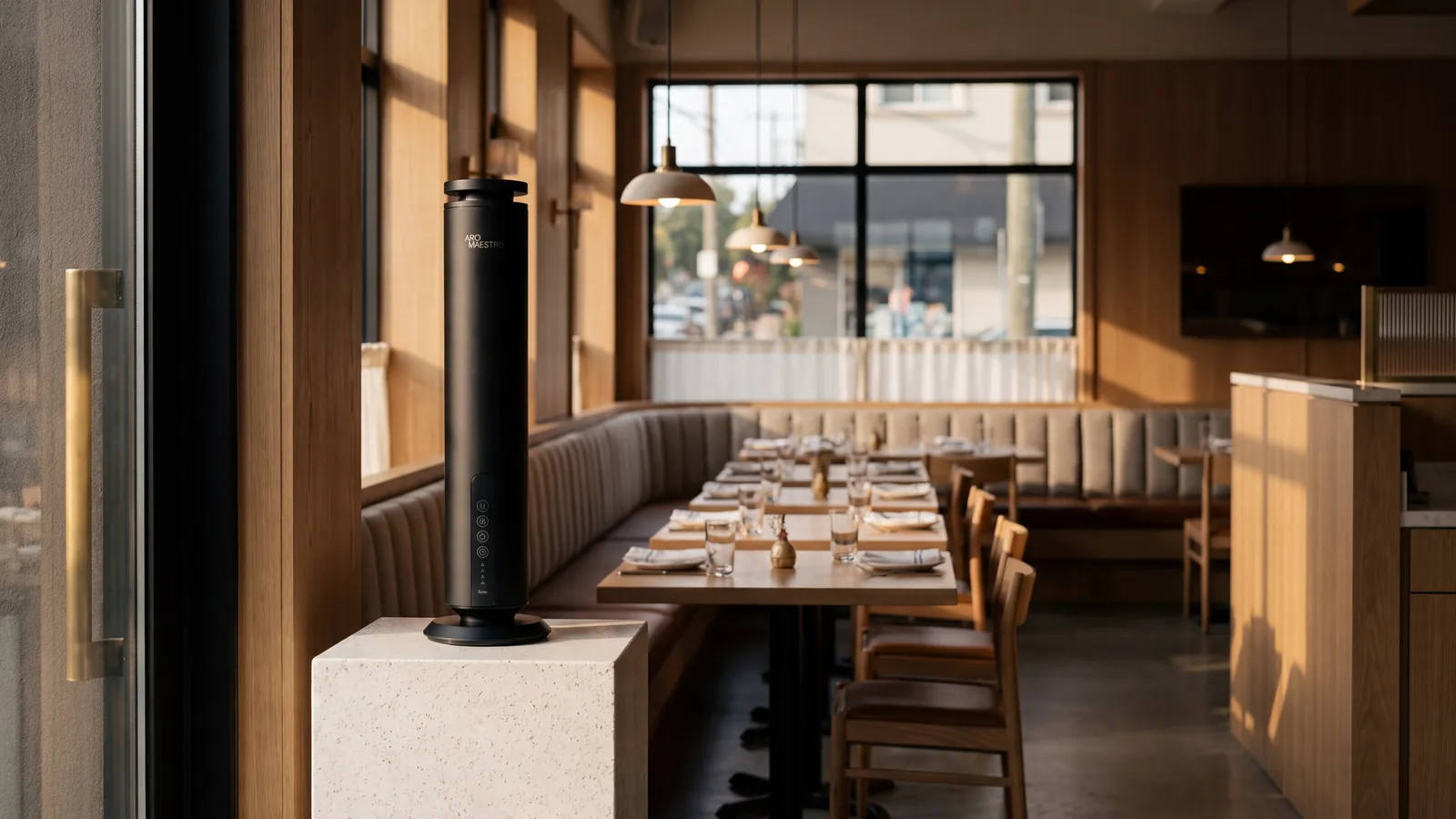
Three conditions separate a scented ambiance that works from a fragrance that bothers people.
Discretion. The fragrance should dress the place, never take it over. Too intense, it produces the opposite of the intended effect.
Consistency. A scent that shows up every other day builds no landmark. Scheduled diffusion holds the same ambiance at all times; our article on connected diffusion explains how.
Safety. In a public place, what goes into the fragrance is not a detail. Fragrances that meet IFRA standards, the strictest in the perfume industry, let you diffuse with an easy mind.
And your customers’ well-being has a natural ally: that of your teams, who live in the same ambiance all day long. We gave it a whole article of its own.
Making fragrance an asset of the customer experience
Your customers’ well-being plays out in the details they never name, and the air they breathe is one of them. Want to discover the olfactory signature that would suit your establishment? We would be glad to advise you. Let’s talk.
Frequently asked questions
Is ambient fragrance safe for customers?
Yes, when the fragrances respect IFRA standards, which govern every perfumery ingredient internationally. That is the standard Aromaestro fragrances are formulated to, for safe diffusion in public places.
What fragrance intensity suits a business?
A discreet intensity, noticeable on arrival without ever imposing itself. Good practice is to adjust diffusion to the floor area and the traffic, then hold it steady with scheduling.
What is an olfactory signature?
An olfactory signature is a distinctive fragrance, created for one establishment, diffused steadily so that it becomes a landmark associated with the brand. Like a logo or a colour palette, but for the sense of smell.
Does scent marketing really work?
It reliably improves how a place is perceived: cleanliness, comfort, quality of the experience. Be wary of spectacular numbers promised on sales; the real and lasting effect is a place where customers feel good and want to come back.